Beyerdynamic DT 1990 Pro Review: 8.7/10 - German precision for critical listening
We may earn a commission from links on this page Learn more
At no additional cost to you. As an Amazon Associate we earn from qualifying purchases; we also participate in the eBay Partner Network (EPN). See our full disclosure.
The Beyerdynamic DT 1990 Pro is a precision instrument for critical listeners who value detail retrieval, build quality, and long-term serviceability above all else.
listeners who want a premium Beyerdynamic audio experience with the Beyerdynamic DT 1990 Pro's german precision for critical listening
your current speaker setup already fills your space well or the Beyerdynamic DT 1990 Pro's price of $549 is too high
Prices last checked July 22, 2026
Overview
The Beyerdynamic DT 1990 Pro is a premium open-back studio reference headphone that leverages Beyerdynamic’s proprietary Tesla driver technology to deliver exceptional resolution and transient response. Released in 2016 and built at Beyerdynamic’s Heilbronn facility in Germany, these headphones are aimed at mixing, mastering, and critical listening applications where detail and accuracy are paramount. At $549, they compete directly with the Sennheiser HD 660S2 and Focal Clear, offering a distinctly analytical presentation that rewards careful upstream equipment choices.
Design & Build
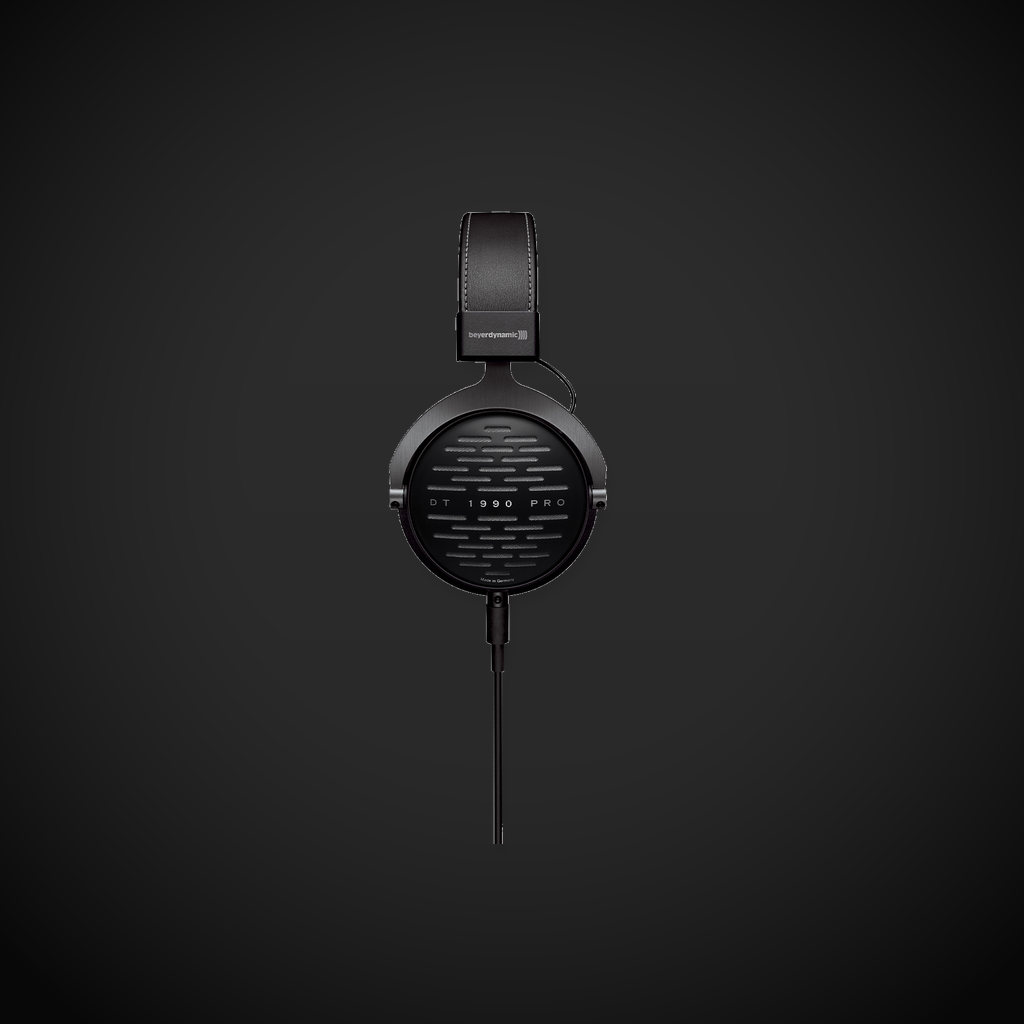
The DT 1990 Pro is built like a tank, with a spring-steel headband covered in a durable padded leather strap, metal yoke assembly, and circumaural velour earpads that are fully replaceable via a simple twist-lock mechanism. The open-back design features a distinctive perforated metal grille that exposes the Tesla drivers, and the overall assembly weighs 370 grams, which is noticeable but well-distributed thanks to minimal clamping force. Two sets of ear pads are included: the factory-installed balanced pads with fewer perforations for a warmer, more diffuse field presentation, and the analytical pads with more perforations for a brighter, more revealing signature. The cables connect via detachable mini XLR connectors at each earcup with a locking mechanism, and Beyerdynamic includes both a 3-meter coiled cable and a 5-meter straight cable, along with a hard-shell carrying case.
Performance
The Tesla driver technology delivers outstanding transient response and detail retrieval, with a frequency response that extends to 40 kHz and a remarkably low total harmonic distortion of less than 0.05 percent at 1 mW. The sound signature is openly revealing, with a pronounced treble presence around 8 kHz that provides exceptional micro-detail but can be fatiguing for treble-sensitive listeners on certain recordings. Bass extension is tight and controlled down to 5 Hz, with excellent impact and speed that suits electronic and percussive content, while the midrange is slightly recessed compared to the HD 660S2, giving vocals a slightly distant presentation. Soundstage width is above average for an open-back dynamic driver headphone, with precise imaging that makes instrument placement easy to discern, though the stage depth is less convincing than planar magnetic alternatives at the same price.
Features
| |Dual-Pad System: The dual-pad system is the DT 1990 Pro’s defining feature, allowing users to switch between the analytical tuning for detailed mixing work and the balanced tuning for more relaxed listening sessions, with a genuine audible difference between the two. High Impedance: The 250-ohm impedance demands a capable headphone amplifier to reach satisfactory volume levels and dynamic expression, and pairing with a clean solid-state amp like the Schiit Magni+ or JDS Labs Atom+ yields optimal results. Serviceability: All components are user-serviceable, with replacement ear pads, headband padding, and cables available directly from Beyerdynamic, ensuring a long service life. The carrying case is large and rigid, offering excellent protection for transport, though it occupies significant space in a studio bag.
| Dual-Pad System: The dual-pad system is the DT 1990 Pro’s defining feature, allowing users to switch between the analytical tuning for detailed mixing work and the balanced tuning for more relaxed listening sessions, with a genuine audible difference between the two. High Impedance: The 250-ohm impedance demands a capable headphone amplifier to reach satisfactory volume levels and dynamic expression, and pairing with a clean solid-state amp like the Schiit Magni+ or JDS Labs Atom+ yields optimal results. Serviceability: All components are user-serviceable, with replacement ear pads, headband padding, and cables available directly from Beyerdynamic, ensuring a long service life. The carrying case is large and rigid, offering excellent protection for transport, though it occupies significant space in a studio bag. |
Category Context
The Beyerdynamic DT 1990 Pro sits in the competitive $500-$600 open-back studio headphone segment alongside the Sennheiser HD 660S2 ($399), the Focal Clear ($990 - a tier above), and the Audio-Technica ATH-R70x ($499). What distinguishes the DT 1990 Pro is its proprietary Tesla driver technology delivering a flux density of over one Tesla in the voice coil air gap, enabling both 5Hz bass extension and 40kHz top-end together with vanishingly low distortion (<0.05% THD at 1mW). The dual-pad system is unique at this price: most competitors offer a single voicing, whereas the DT 1990 Pro’s balanced and analytical pads provide genuinely different frequency responses for mixing versus casual listening. However, the 250-ohm impedance is the highest in this peer group (e.g., HD 660S2 is 300 ohms but more sensitive at 104dB), demanding a quality amplifier to perform. The all-metal German construction and full user-serviceability also set it apart from the plastic-heavy Sennheiser HD 600 series, making it the durability leader.
Pros
-
Exceptional detail retrieval and transient response from the proprietary Tesla driver technology, with micro-detail that reveals flaws in recordings and mixing decisions that lesser headphones gloss over. The analytical pads are particularly revealing for critical mastering work.
-
Outstanding build quality with all-metal construction, replaceable ear pads and cables, and German manufacturing standards that make these headphones capable of lasting a decade or more with proper care.
-
The dual-pad tuning system genuinely offers two distinct sound signatures for different use cases, from analytical studio work to comfortable casual listening, without requiring any EQ adjustments.
-
Excellent bass extension and impact with tight, controlled low-end response that suits genres ranging from electronic to orchestral music, all with vanishingly low distortion.
Cons
-
The treble peak around 8 kHz is aggressive and can cause listening fatigue during extended sessions, particularly with recordings that have significant energy in the upper frequencies. The balanced pads help but do not eliminate the peak entirely.
-
Requires a dedicated headphone amplifier due to the 250-ohm impedance, and will sound thin, lifeless, and quiet when driven from a laptop or phone jack without external amplification.
-
The midrange is slightly recessed compared to competitors, giving vocals and acoustic instruments a less immediate, less intimate presentation than the Sennheiser HD 660S2 or HD 600.
-
At 370 grams, the DT 1990 Pro is heavier than many competitors, and while the headband distributes weight well, the overall mass becomes apparent during sessions exceeding two hours.
Verdict
The Beyerdynamic DT 1990 Pro is a precision instrument for critical listeners who value detail retrieval, build quality, and long-term serviceability above all else. It demands good upstream amplification and rewards careful partnering with stunning clarity, but the aggressive treble and slightly recessed midrange make it a specialist tool rather than an all-rounder. For mixing engineers and detail-oriented audiophiles who know exactly what they are listening for, the DT 1990 Pro remains one of the finest dynamic headphones under $600.
Sources
Technical Specifications
How We Scored This Product
Every product on ComfyTechCheck is scored on a 1 to 10 scale across four criteria. Each criterion is weighted differently depending on the product category to reflect what matters most to real buyers.
- Performance & Capabilities 40% Speed, accuracy, quality of output in its category.
- Build & Design Quality 30% Materials, construction quality, durability, form factor.
- Consumer Value 20% Price-to-performance ratio relative to direct competitors.
- User Experience 10% Ease of setup, daily usability, comfort, ergonomics.
Scores are assigned by our editorial team after hands-on testing or extensive research using verified user reports, expert analysis, and technical specifications. For the full weight breakdown by category, visit our How We Rate page.